Showing posts with label picture book. Show all posts

Wednesday, March 18, 2020

More STEAM Resources In the Time of COVID-19

Here are more STEAM resources for parents, teachers, and kids during this time of isolation. 


  1. Palm Oil Audit – Is your household making orangutan-friendly choices at the grocery store? Find out with this eye-opening activity.
  2. Happy Rhinos – Build a rhino-safe enclosure and connect kids to endangered species using design thinking and language arts.  
  3. Ocean Clean-Up Design Challenge – Create a device that will clean up our oceans.
  4. Aging Plastic Experiment – Does plastic every go away? Try this experiment to find out. 
  5. A Language of Your Own - Elephants use many different sounds to communicate emotion. Challenge kids to use sounds and movements to convey emotions (fear, greeting, sadness, excitement, warning, surprise, etc.) without using words. Guess what emotion they are trying to convey.
And for more --check out Patricia Newman’s LitLinks blog series that highlights the connection between STEM and language arts using children’s books: https://www.patriciamnewman.com/blog-4/. 

~~~~~~~~~~~~~~~~~~~~~~~~~~~~~~~~~~~~~~~~~~~~~~~~~~~~~~~~~~~~~~~~~~~~~~~~~~~
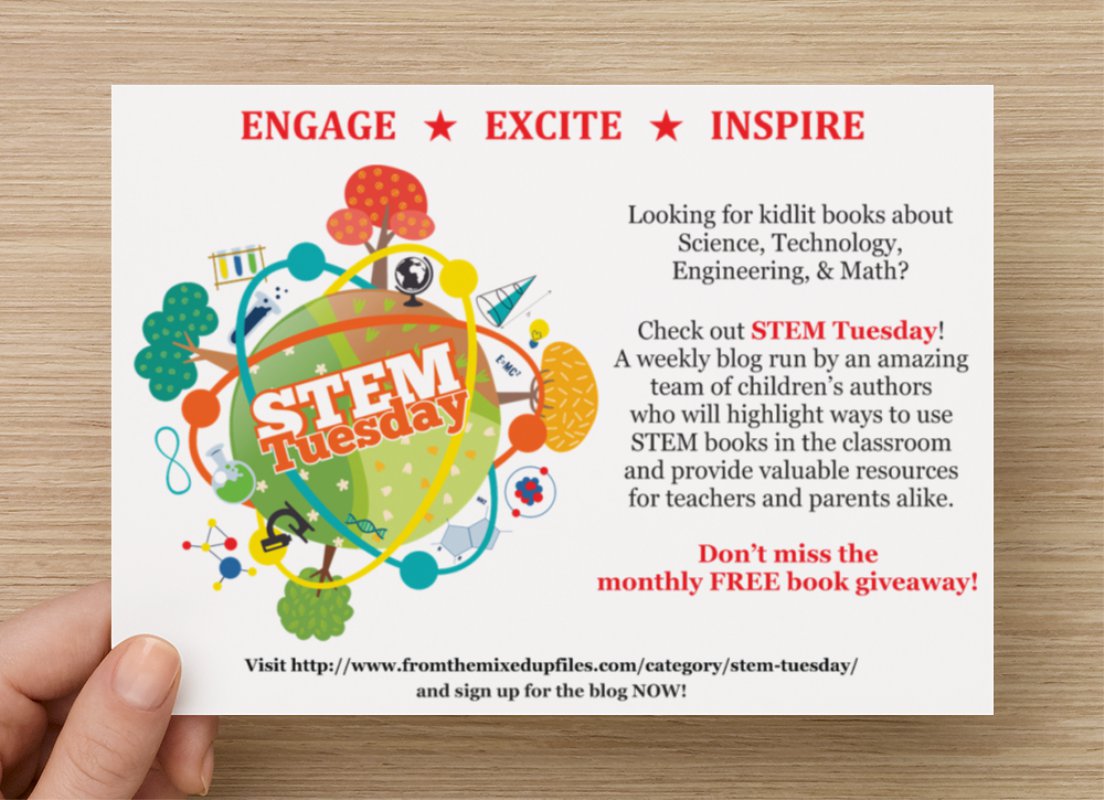
Patricia and I contribute to another great resource  - STEM Tuesday, where you'll find middle-grade STEM monthly book lists and activities for home and classroom. 


~~~~~~~~~~~~~~~~~~~~~~~~~~~~~~~~~~~~~~~~~~~~~~~~~~~~~~~~~~~~~~~~~~~~~~~~~~~

Here's a great video from picture book author Randi Miller Sonenshine to pair with THE NEST THAT WREN BUILT:


And a STEAM activity too!

~~~~~~~~~~~~~~~~~~~~~~~~~~~~~~~~~~~~~~~~~~~~~~~~~~~~~~~~~~~~~~~~~~~~~~~~~~~~~

For BACK FROM THE BRINK readers -- YOUR VOICE MATTERS: 


Be well, readers! 

Wednesday, December 11, 2019

Researching STEM Kidlit - Welcome Guest Blogger - Carrie Pearson

FIVE STEPS TOWARD RESEARCHING THAT WHICH YOU CANNOT SEE -- AND NEVER WILL 
I grew up climbing trees. If I was nowhere to be found, my family knew to look for me in the sugar maple in our backyard. I hauled up my knobby kneed self by grabbing a limb close to the ground, then pulled, pushed, and shimmed higher and higher until I’d found the perfect crook in which to read my book of choice. Ah, bliss.
So it was no surprise I was drawn to a special tree -- this time, a coast redwood -- as the subject for my third nature book. 


But this ecosystem is a bit different.  
Coast redwood branches begin growing far off the ground so it’s impossible to grab a limb and haul oneself up into a tree. Instead, tall tree researchers stand at the base of a coast redwood and shoot an arrow with a line attached toward the lowest branch. Hopefully the line loops over the limb, falls to the ground and can be leveraged with mountain climbing carabiners to haul the researcher up, up, up. 
However, I’m not a tall tree researcher. And, as I’ve, um, matured, I’m less fond of heights. To make matters more difficult, I knew I would not be allowed to visit the main character in my manuscript -- the tallest tree on earth.  
To guard it from even well-meaning people like me, this is tree is protected and its location is kept secret. Even if it wasn’t, finding it in the midst of the 131,983 acres of Redwood National and State Park would be an extreme undertaking at the very least. But I was smitten with the life story of this tree. 
So, here we are at the title for this blog post. How does a writer of true stories research that which she cannot see and never will? 

Step One: choose a topic for which your passion knows few bounds. Somewhere inside, I knew I’d get there. Don’t ask me how I knew this but my need to create this book for children was as big as the tree itself.
Step Two: Begin with inquiry. I drew up list of questions that I felt I would need to answer before I knew enough to write the book. The who, how, when, where and why’s would guide my research. 
Step Three: Find the experts. I searched for people who had experienced the tree firsthand. I read and watched everything these people had shared in every format possible. Thankfully, the secondary research troves were deep. When I began to find the same answers for my questions, even though I approached the questions differently, I was ready for the next research step.
Step Four: Ask for help. I wrote and was awarded an SCBWI research grant to visit the Park because I knew other’s experiences could take me only so far. Even though I wouldn’t see “my” tree, I’d enlist all my senses to get as close a feel for it as I could. Fortuitously, the Park paired me with a guide, Park Ranger James Wheeler, who had spent 30 plus years in that world. 


Step Five: Stop researching and listen for the story. Mr. Wheeler’s insights, other experts’ knowledge, combined with my redwood forest immersion, allowed me to begin to hear the narrative for STRETCH TO THE SUN: FROM A TINY SPROUT TO THE TALLEST TREE ON EARTH. 
Even though I’d never seen the tree and knew I never would, in a way, I had. 


Carrie A. Pearson is a children’s book author, consultant, speaker, and former teacher. She is a Regional Advisor for the Society of Children’s Book Writers and Illustrators, a member of several literacy-focused organizations, and the recipient of the Gwen Frostic Award for Literacy given by the Michigan Reading Association. She is the author of two informational fiction picture books, A Warm Winter Tail and A Cool Summer Tail (Arbordale Publishing) and a narrative nonfiction picture book, Stretch to the Sun: From a Tiny Sprout to the Tallest Tree on Earth (Charlesbridge), a Eureka! Award recipient for outstanding nonfiction given by the California Reading Association. A picture book biography about medical trailblazer, Dr. Virginia Apgar, launches fall 2020 with Norton Young Readers. A picture book anthology about unexpected women who are changing the world will be announced soon. Carrie would love to connect with you on Twitter @carrieapearson, Pinterest carrieapearson, and through her website www.carriepearsonbooks.com.
For more about STRETCH TO THE SUN and the path to its publication, visit this page on her website: http://www.carriepearsonbooks.com/stretch-to-the-sun-picture-book.html


--------------------------------------------------------------------------------------------------------------------------------


Nancy Castaldo has been writing about the planet for over 20 years. Learn more about her award-winning books at http://www.nancycastaldo.com Purchase and pre-order autographed copies of Nancy's books here. 


Wednesday, May 23, 2018

World Turtle Day!

I have always loved turtles! In fact, I even trained to be a turtle rehabilitator. Have you wondered about the difference between turtles and tortoises? Well, both are reptiles that belong to the order Tesdunes, but they fall into different classification families. A major difference, and easy way to tell them apart, is that turtles live in or near the water and tortoises live on land.

I have swam with sea turtles and walked among giant tortoises, but you don't have to go far to enjoy these special creatures. I bet that you can find some turtles out sunning themselves on a rock in your local pond. Most common of these are painted turtles. They are easy to spot since they live across North America.

If you are itching to know more about turtles, check out these books.  And for a look at sea turtles and giant tortoises read my latest BACK FROM THE BRINK!


Monday, January 13, 2014

Interview: Melissa Stewart, Author of No Monkeys, No Chocolate

 Melissa Stewart is the author of many fantastic nonfiction books on topics ranging from deadly predators to earthquakes.  With her recent picture book, No Monkeys, No Chocolate, she takes readers to tropical rainforests, the very source of the chocolate we eat. If you like chocolate, you’ll love this book!  It even has wise-cracking bookworms that comment on everything. 


Thanks, Melissa, for speaking with us today about No Monkeys, No Chocolate.

 
Can you tell us about the process of writing this very kid-friendly text with a leading scientist?
Thanks so much for your kind words about No Monkeys, No Chocolate, Nancy. This book was 10 years in the making. I thought kids, teachers, and aspiring authors might be interested in the story behind the book, so I created a fun Interactive Timeline. 

Allen Young is the world’s leading expert cocoa growth and pollination. He didn’t actually do any of the writing, but he did provide key bits of information that I couldn’t get anywhere else. His knowledge was based on working with cocoa trees in the Costa Rican rain forest for more than 30 years.

The bookworm narration adds a wonderful dimension to the text. Was that fun to write?
I had a blast writing the bookworm dialog. The trick was to keep the exchanges short while also making them funny and packing them with information that reinforced the main text.

No Monkeys, No Chocolate is chock-full of great information. Did anything surprise you in your research?
There were so many surprises. Before I began working on this book, I had no idea that a tiny fly pollinates cocoa or that monkeys and a couple of other small mammals disperse their seeds.

I also learned lots of interesting information that didn’t make it into the book. There were many different candidates for the spots occupied by the anole lizard and the coffin flies. Each one had an interesting relationship to the tree responsible for our favorite dessert. In the end, I chose the coffin flies and their brain-eating maggots because they are just so gross and cool. I chose the lizard and aphids, as a tribute to the rose-slurping aphids that inspired me to write the book in the first place.

I’m sure teachers would love to add this to their library. Do you have any tips on how teachers can use No Monkeys, No Chocolate in their classroom?
Yes, I have a Teacher’s Guide, Readers Theater, and several activity sheets that go with the book. You can find them here.  Also, the book was featured on the ClassroomBookshelf blog, where three super-smart educators from Lesley University offer lots more ideas. They’ve even included some ideas for using the Interactive Timeline in the classroom.

What are you working on now?
My newest picture book,
Feathers: Not Just for Flying will be published in February, and I’m very excited about it. Illustrator Sarah S. Brannen did a fantastic job. Right now, I’m working on a video to go with the book. I’m also putting he final touches on the Teachers Guide and a Readers Theater that I think teachers will really like.


To learn more about Melissa and her books visit her
website  or her blog  You may also want to follow her on Twitter, @msterwartscience, or on Pinterest.


Thursday, January 5, 2012

Review - NF Picture Book Challenge, Week #1 - Thunder Birds by Jim Arnosky

Jim Arnosky is a pro at wildlife illustration and this book is no disappointment.  In Thunder Birds, Arnosky has chosen to highlight the biggest and strongest of birds.  He mixes his wonderful personal narrative with fold-out  life size illustrations that will thoroughly engage readers, both young and old.  This book will definitely inspire readers to grab a pair of binoculars and search out their own "thunder birds".

Tuesday, January 3, 2012

Nonfiction Picture Book Challenge 2012


Announcing: The Nonfiction Picture Book Challenge 2012
I'm excited to announce the
2012 Nonfiction Reading Challenge. 
The goal is to encourage everyone to read more nonfiction picture books this year.
Take the challenge by setting a goal for yourself.
Maybe you want to read one nonfiction picture book each week or each month.
Visit both the Kid Lit Frenzy and The Nonfiction Detectives blogs
throughout the year for nonfiction reviews and giveaways!
Tweet about the challenge using the hashtag #nfpb2012.

Happy SEED SWAP DAY!

In light of the celebration of SEED SWAPPING DAY on January 31st, I'm posting this blog post again with a few updates -- so SEED ON!  ...