Showing posts with label oceans. Show all posts

Tuesday, March 3, 2020

Women's History Month - Beneath the Waves

Women have been exploring life beneath ocean waves for centuries. These books examine those women and their discoveries. Choose a few to read to your budding oceanographers this spring.


_________________________________________________________________________


Wednesday, January 29, 2020

Researching STEM Kidlit - Welcome Guest Blogger Patricia Newman

Two Friends Who Want to Change the World


     When Nancy invited me to participate in this Behind the Story blog series, I immediately said yes, but I confess I didn’t know which book to write about. She had already featured Eavesdropping on Elephants,  Zoo Scientists to the Rescue, and Plastic, Ahoy! so her readers know many of my backstories. But then I realized there is one back story no one knows, and it centers around a special friendship.

     On a sweltering August day in 2009, I first read about a group of graduate students sailing to the North Pacific Central Gyre (aka The Great Pacific Garbage Patch) to study the plastic accumulating there. As I dug deeper, I discovered the expedition also included Annie Crawley as the official photographer and filmmaker. As the first ripples of an idea for Plastic, Ahoy! gathered momentum, I knew I would not only need the scientists’ endorsement, but Annie’s as well. Annie was as pivotal as the scientists because the expedition traveled 1,000 miles from land. Without Annie, there would be no photos for my book idea.

     I remember rather nervously cold-calling Annie to pitch my idea (which hadn’t yet sold). Already an important ocean advocate and member of the Women Divers Hall of Fame, Annie used her cameras to tell the ocean’s story. Her social media feeds (Instagram, Facebook, Twitter) and YouTube channel are filled with astonishing images and short videos.

     In these early days of Plastic, Ahoy!, few people were even aware of our ocean’s plastic problem, let alone discussing it, so Annie was intrigued by my idea. Well, maybe more than intrigued. “I was full-on in from the get-go,” she says, “because by the time you contacted me, I had already been up against nobody wanting to talk trash [literally]...so I was ecstatic you wanted to pitch a book idea. I knew kids would get it.”

Annie (R) and I met for the first time in the summer of 2014 on the banks of the Puget Sound in Washington.


     As we moved forward, Annie became a valuable partner in telling the story of Plastic, Ahoy! visually. If you’ve read the book, you’ve seen her compelling photos!

     We bonded over the book’s layout, the trailer, blog posts, and sharing our love of the sea. We knew we had to work together again!

     When Annie and I traveled to Washington, D.C. to receive our Green Earth Book Award for Plastic, Ahoy!, we already had our next book in mind: Zoo Scientists to the Rescue. While in D.C., we stopped at the Smithsonian’s National Zoological Park to interview Meredith Bastian, the orangutan scientist featured in Zoo Scientists to the Rescue.

     But that wasn’t all. Next, we traveled to the Cheyenne Mountain Zoo and the National Black-footed Ferret Conservation Center in Colorado and the Lincoln Park Zoo in Chicago. We navigated a Colorado blizzard, were scolded by an angry black-footed ferret, charged by Maku the black rhino, and stayed at Annie’s childhood home in Chicago. We laughed, hoped for good photo weather, shared frustrations, and solved problems as we created the text and photo story together.

 Annie (L) at work on Zoo Scientists to the Rescue in Dr. Rachel Santymire’s (R) lab


     The friendship has blossomed. I’ve met her family; she’s met mine. We’ve presented together at various events, shared news stories about the ocean, and searched for another book idea.

     Which turned out to be right under our noses. Annie’s work as a scuba diver, dive instructor, photographer/filmmaker, and ocean educator/advocate became the foundation for Planet Ocean: Why We All Need a Healthy Ocean (Millbrook Press, October 6, 2020—available for pre-order on Amazon).

My first scuba lesson with Annie (R).


      In the book Annie and I demonstrate how we are all inextricably linked to the sea—the air we breathe, the water we drink, and the food we eat. We take a deep dive into three of Annie’s favorite ocean regions—the Arctic, the Salish Sea in the Pacific Northwest, and the waters around Indonesia in the heart of the Coral Triangle—to understand how pollution and climate change affect the sustainability of each region. We also introduce readers to local people fighting to save the ocean. Planet Ocean mixes STEM, current events, and global cultures, with a strong message of empowerment. We want young readers to use their storytelling skills to be the voice of the ocean. (I’m sorry I can’t yet share a cover or a trailer yet—we’re still in production mode! Stay tuned for lots more about Plant Ocean this fall.)
Annie and I interview Meg Chadsey (L) with Washington Sea Grant for PLANET OCEAN


     Meeting and working with Annie Crawley is one of the most satisfying “backstories” of my life. We’re two friends who want to change the world

Annie in her element

   Patricia Newman's books inspire young readers to seek connections to the real world. Titles such as Planet Ocean; Sea Otter Heroes; Plastic, Ahoy!; Eavesdropping on Elephants; and Zoo Scientists to the Rescue encourage readers to use their imaginations to solve real-world problems and act on behalf of their communities. A Robert F. Sibert Honor recipient, Patricia’s books have received starred reviews, Green Earth Book Awards, a Parents’ Choice Award; been honored as Junior Library Guild selections; and been included on Bank Street College’s Best Books lists. Patricia frequently speaks at schools and conferences to share how children of any age can affect change. Visit her at www.patriciamnewman.com.


--------------------------------------------------------------------------------------------------------------------------
Nancy Castaldo has been writing about the planet for over 20 years. Learn more about her award-winning books at http://www.nancycastaldo.com Purchase and pre-order autographed copies of Nancy's books here. 


Friday, June 16, 2017

Happy World Sea Turtle Day

Last year I spent time with sea turtles in the Galapagos, Florida Keyes, and Australia. What a treat!


One of the most amazing places I visited was the
Turtle Hospital in the Florida Keys. This nonprofit organization rescues turtles that suffer from impactions, caused from eating things like balloons, boat strikes, and illnesses. I was so impressed with this organization that I donated a portion of my Authors for Earth Day April school visit proceeds to The Turtle Hospital to further their efforts.


Even though there are conservationists, veterinarians, marine biologists, and volunteers working at this place and others on behalf of the world's sea turtles, they are still under threat.

One major threat is gill net fishing. The long, near-invisible nets used with this method of fishing threaten many marine animals. They are used to catch swordfish, but they also trap whales, dolphins, and sea turtles. These creatures become by-catch and most often die without being released.

Proposed regulations would ban these nets for a period of up to two years, but the current administration is tossing out these regulations. That marks a serious blow for sea turtles and other marine life.

On this World Sea Turtle Day let's do something to help protect sea turtles around the world. Donate to sea turtle conservation, contact your officials, or learn about their species and plight.

Here are three favorite sea turtle reads to inform and enjoy on this World Sea Turtle Day!


Follow the Moon book and song by Sarah Weeks


Mission: Sea Turtle Rescue by Karen Romano Young & Daniel Raven-Ellison


Sea Turtle Scientist by Stephen R. Swinburne


SaveSaveSaveSave

Wednesday, July 9, 2014

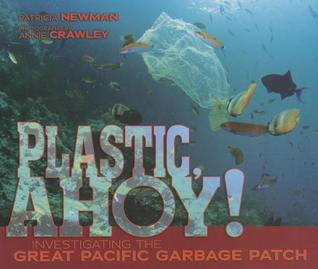
Plastic, Ahoy! by Patricia Newman


Whether you're taking a cruise, swimming in the ocean, or having a tuna sandwich at your next picnic, the ocean impacts all of our lives. More of our world is covered by ocean water than land. Author Patricia Newman has written an engaging, thought provoking book for kids about the plastics that have invaded our seas.

I had the opportunity to find out more about the complexities of writing this book and the way it can be used in classrooms on a recent chat with the author! 

Thanks, Patricia, for being with us today and talking about Plastic Ahoy! The book brings a very huge dilemma to readers. What was the inspiration for telling this story? 

The inspiration for PLASTIC, AHOY! started with an article in my local newspaper about graduate student scientists and volunteers who boarded a research vessel in August 2009 to sail to what the media calls the Great Pacific Garbage Patch. The Garbage Patch was first discovered by Captain Charles Moore, but until 2009 it had not been scientifically studied. This expedition funded by the Scripps Institute of Oceanography and Project Kaisei would be among the first. While I followed the expedition blog, several facts and fragments coalesced into a possible book idea—the age of the scientists, the open ocean adventure, the “first-of” nature of the expedition and the fact that we had the power to reduce ocean plastic. I traveled to San Diego to interview some of the scientists after they returned to shore and I knew I had a solid idea.

The researchers in the book spend countless hours at sea. Can you tell readers about your own research for this title?

I proposed to my editor a nonfiction picture book for grades  3 through 6, so I had space constraints to deal with, i.e. 3,500 to 4,000 words of text. Seven graduate student scientists gathered observations and data for later research based on this expedition, but I knew that I did not have space to discuss all seven. I printed the expedition blog (all 21 days of it!) so I could highlight and annotate. I chose scientists whose work would feature different facets of ocean plastic: Miriam Goldstein (the lead scientist) focused on the rafting community—the little critters who hitchhike aboard plastic; Darcy Taniguchi studied phytoplankton—microscopic plants that provide the oxygen for nearly two out of every three breaths we take; and Chelsea Rochman studied the chemistry of plastic and how contaminants leach out of plastic and also adhere to it.

I interviewed each scientist for several hours, studied up on the scientific terminology surrounding ocean plastic, watched expedition photographer Annie Crawley’s gorgeous videos of the expedition, and read everything about ocean plastic that I could find, both online and in print.  It wasn’t until I started writing that I realized I had chosen three female scientists, which lent an element of “girl power” to an already powerful STEM concept.

Did you experience any challenges in writing this book?

Every book I write comes with its own set of challenges. For me, the hardest part of any nonfiction project is deciding which format is best suited to my story. I chose a narrative format for two reasons—the plastic floating in the ocean is mysterious and that sense of mystery lent itself to storytelling. At the time I wrote the book, we didn’t know much about ocean plastic. The expedition was the epitome of the scientific method at work because the scientists went to sea armed only with questions. They didn’t know what they would find. The second reason I chose a narrative format was because I wanted to include specific information about each of the three wonderful scientists that I met. These women love science and I knew their passion would not only engage young readers, but hopefully interest them in science.

Plastic, Ahoy!’s message poses another challenge. The process of research and writing this book changed the way I look at the ocean and how the products I buy affect it. One of my goals in writing the book was to build a strong case for cleaning up our oceans and rivers and showing readers how to become more ecologically responsible.
Now that readers are interacting with PLASTIC, AHOY! I hope they will change their own habits and help spread the message.


The photographs in Plastic Ahoy really bring the story to life. Can you share with us your working relationship with photographer, Annie Crawley?
Annie Crawley  and I met because of Plastic, Ahoy! (Actually, we still haven’t met face-to-face, but we talk on the phone a lot!) I contacted Annie after the expedition returned to shore to be sure she was on board with the project. She and I scrolled through thousands of images and video of the expedition looking for just the right shot, the right angle, the perfect photo that showed how scientists lived and worked on board New Horizon. Annie’s photos capture the enormity of the plastic problem. She also used her award-winning video talents to create our dynamite booktrailer .

Annie is tireless in her defense of the ocean. She’s a noted ocean speaker, a member of the Women Divers Hall of Fame and the CEO of Dive Into Your Imagination. Annie runs dive camps for kids and photography camps for any age. I am so lucky to have her photos grace Plastic, Ahoy! and we look forward to working on another project together (we have two ideas we’re currently considering).

This book hits on some important core curriculum standards. Any suggestions for using it in the classroom?

I used to teach remedial math to high school students, so I understand that real world examples can facilitate learning. In addition to cutting-edge information about ocean plastic, PLASTIC, AHOY! provides a fabulous segue to the scientific method. My Teacher Guide <http://patriciamnewman.com/CCSSPlasticAhoyGuide.pdf> (http://patriciamnewman.com/CCSSPlasticAhoyGuide.pdf <http://patriciamnewman.com/CCSSPlasticAhoyGuide.pdf> ) is aligned with the Common Core State Standards and the Next Generation Science Standards. The guide contains a variety of activities that stress vocabulary for the ocean and the scientific method; the ocean food web and how energy is transferred to each organism; forming a hypothesis; and (my favorite) a math activity where students conduct a waste audit analysis of their homes. The last few pages of the activity guide lists in table form the CCSS and NextGen standards covered by each activity.

What’s next for your readers?


Four nonfiction novelty board books will be released in the fall of 2015 and spring of 2016. I love these books and am very excited to see how the parents of toddlers react to them. Additionally I have several projects—both fiction and nonfiction—that have just been submitted for an editor’s consideration or will be submitted soon.

Thank you, Patricia! This has been great. Plastic Ahoy! is a must for classroom bookshelves. It seems like this topic appears again and again in the news. Thanks for providing readers with a good resource!  

Find out more about Patricia's books at http://www.patriciamnewman.com

Sunday, February 12, 2012

Nonfiction Picture Book Challenge - Coral Reefs


Jason Chin has done it again. He's created another great title to add to your nonfiction bookshelf.   This time he's taken us from the redwood forest to under the sea in his latest book, Coral Reefs.  Again, Chin offers readers informative text and beautiful, imaginative illustrations.  In Coral Reefs, a young girl enters the New York Public Library, pulls a book about coral reefs off the shelf and finds herself in the undersea world she's reading about.  The text is straight nonfiction, while the illustrations offer the reader a healthy dose of magical realism.  I love the idea of text coming alive for readers and Chin has done a beautiful job of capturing the beauty of the reefs. His text, however, is not as creative as his illustrations.  Nonetheless, this title is an example of how creative nonfiction can be, while still providing readers with great information!

Happy SEED SWAP DAY!

In light of the celebration of SEED SWAPPING DAY on January 31st, I'm posting this blog post again with a few updates -- so SEED ON!  ...