Showing posts with label STEAM. Show all posts

Wednesday, March 18, 2020

More STEAM Resources In the Time of COVID-19

Here are more STEAM resources for parents, teachers, and kids during this time of isolation. 


  1. Palm Oil Audit – Is your household making orangutan-friendly choices at the grocery store? Find out with this eye-opening activity.
  2. Happy Rhinos – Build a rhino-safe enclosure and connect kids to endangered species using design thinking and language arts.  
  3. Ocean Clean-Up Design Challenge – Create a device that will clean up our oceans.
  4. Aging Plastic Experiment – Does plastic every go away? Try this experiment to find out. 
  5. A Language of Your Own - Elephants use many different sounds to communicate emotion. Challenge kids to use sounds and movements to convey emotions (fear, greeting, sadness, excitement, warning, surprise, etc.) without using words. Guess what emotion they are trying to convey.
And for more --check out Patricia Newman’s LitLinks blog series that highlights the connection between STEM and language arts using children’s books: https://www.patriciamnewman.com/blog-4/

~~~~~~~~~~~~~~~~~~~~~~~~~~~~~~~~~~~~~~~~~~~~~~~~~~~~~~~~~~~~~~~~~~~~~~~~~~~
Patricia and I contribute to another great resource  - STEM Tuesday, where you'll find middle-grade STEM monthly book lists and activities for home and classroom. 


~~~~~~~~~~~~~~~~~~~~~~~~~~~~~~~~~~~~~~~~~~~~~~~~~~~~~~~~~~~~~~~~~~~~~~~~~~~

Here's a great video from picture book author Randi Miller Sonenshine to pair with THE NEST THAT WREN BUILT:


And a STEAM activity too!

~~~~~~~~~~~~~~~~~~~~~~~~~~~~~~~~~~~~~~~~~~~~~~~~~~~~~~~~~~~~~~~~~~~~~~~~~~~~~

For BACK FROM THE BRINK readers -- YOUR VOICE MATTERS: 


Be well, readers! 

Monday, March 16, 2020

STEAM Resources in the Time of COVID-19

Here is a list of resources for parents, teachers, and kids to use during (and after) this period of isolation. Let's explore the world from the comfort and safety of our own homes!


If you enjoyed reading about the recovery of wolves in BACK FROM THE BRINK: SAVING ANIMALS FROM EXTINCTION check these out:

The Wolf Conservation Center is offering FREE distance learning programs to schools across the US.  Sessions can be taught via SKYPE, Zoom, Google hangout and more!

While you are on the Wolf Conservation site - check out the 8 webcams! Here is one of my favorites. Can you howl like a wolf?

Here is a short reader's guide for BACK FROM THE BRINK.

~~~~~~~~~~~~~~~~~~~~~~~~~~~~~~~~~~~~~~~~~~~~~~~~~~~~~~~~~~~~~~~~~~~~~~~~~~~


Here is an engineering design activity from STEAM author Kirsten Williams Larson based on her book, WOOD, WIRE, WINGS.


~~~~~~~~~~~~~~~~~~~~~~~~~~~~~~~~~~~~~~~~~~~~~~~~~~~~~~~~~~~~~~~~~~~~~~~~~~~

Take a tour - VIRTUALLY - at these great institutions!

Smithsonian National Museum of History   My favorite spot is the Ocean Hall on the first floor. Check it out.

Here are a couple of great books to read for your journey:


Check out SCIENCE SNACKS at the Exploratorium! There are so many to choose from.
I like -- BEE HUMMER.

Read this new picture book with your activity:


~~~~~~~~~~~~~~~~~~~~~~~~~~~~~~~~~~~~~~~~~~~~~~~~~~~~~~~~~~~~~~~~~~~~~~~~~


Monday, March 2, 2020

Women's History Month - Ada Lovelace!

It's about time Ada got a little love. After all, Ada Lovelace is a major figure in the history of computers. AND she became part of this history before computers even existed.

I had a blast writing my own ADA LOVELACE book, published by DK Lifestories in 2019. Here are the others. Take a look at them all and compare and contrast how each author tackled the story of this amazing woman.


Wednesday, November 6, 2019

Researching STEM Kidlit - Guest Blogger - Mary Kay Carson

Mission to Write a Book About Pluto


Kids love Pluto. When I’m giving an author visit presentation about the solar system at schools and question time comes around—half of those hands in the air are attached to students asking something about Pluto.

So when the first-ever spacecraft to Pluto finally launched in 2006, I knew I wanted to write a book about it. Fortunately, I had 9½ years to figure it out. Pluto is 3 billion miles away. The robotic probe spacecraft New Horizons wouldn’t reach the (then) farthest planet until mid 2015. 

Full disclosure, I’m a bit of space geek. Space stuff is all just so cool—spacecraft dodging the rings of Saturn, telescopes that see back in time, lakes of methane on Titan, etc. And I’ve been writing about space for kids since (gulp!) 1991 when I worked at Scholastic’s SuperScience magazine.

But back to Pluto. By the time New Horizons was closing in on its target, I’d written a few books in Houghton Mifflin’s Scientists in the Field series. So, I successfully pitched a Pluto book to my editor there. Late in 2013 myself and my photographer husband Tom Uhlman had contracts. Now all we had to do was make it happen. 


Writing about real time stuff can be tricky. The manuscript deadline was August of 2015, a month after the July 2015 scheduled arrival of New Horizons at Pluto. The plan was to get the book out as soon after the (hopefully successful) mission happened as possible. What that meant in practical terms was that I needed to write most of the book before a spacecraft actually visited Pluto.

New Horizons’ is headed up by planetary scientist Alan Stern. He’s Pluto’s #1 fan, one of Time magazine’s 100 Most Influential People in The World, and a very busy person. When I contacted him about the book project, he suggested focusing on the team of scientists, instead of just himself. That seemed great as it’d give some depth to the book to have women and people from other nations featured. Plus, in truth, I’ve gotten burned on book projects that rely on a single person, so was happy to have eggs in multiple baskets.

There was a complication, however. “Team New Horizons” doesn’t live in one place. The (ongoing) mission is based out of Johns Hopkins University Applied Physics Laboratory (JHAPL) in Laurel, Maryland. That’s where the engineers and operations people are. But Alan Stern and some of the other planetary scientists are at the Southwest Research Institute in Boulder, Colorado. Others are at the University of Colorado as well as the SETI Institute in Silicon Valley, California. And some of the press conferences surrounding the Pluto flyby would be held at NASA in Washington, D.C. Can you say logistics?

The team would be together in Maryland at JHAPL for the Pluto Flyby event in July of 2015, of course. But that would be too late to get interviews and photos of folks at work, a requirement of Scientists in the Field books. Plus we weren’t even sure early on whether we’d get press passes to the flyby event. Thankfully, we were able to crash a meeting of the New Horizons science team in Boulder in the fall of 2014. We got great photos of scientists explaining their research. (Check.) And I got some facetime with scientists. 


In early 2015 I traveled to JHAPL in Maryland to meet with some operations people and have a tour of mission control. (Check.) Between then and the Pluto Flyby in the summer, I followed up with telephone interviews with the individual team members. All this added up to getting credentialed for the Pluto flyby event! (Check!) Plus now that the team members featured in the book knew us, we had a bit more access to them than we would have had otherwise. 


Being at the New Horizons Pluto Flyby event made all the logistics and hard work worthwhile. The press pass still hangs on my bulletin board! It was so exciting to be in the auditorium with scientists and reporters from around the world as the very first ever images of Pluto’s surface came in. Wow! 

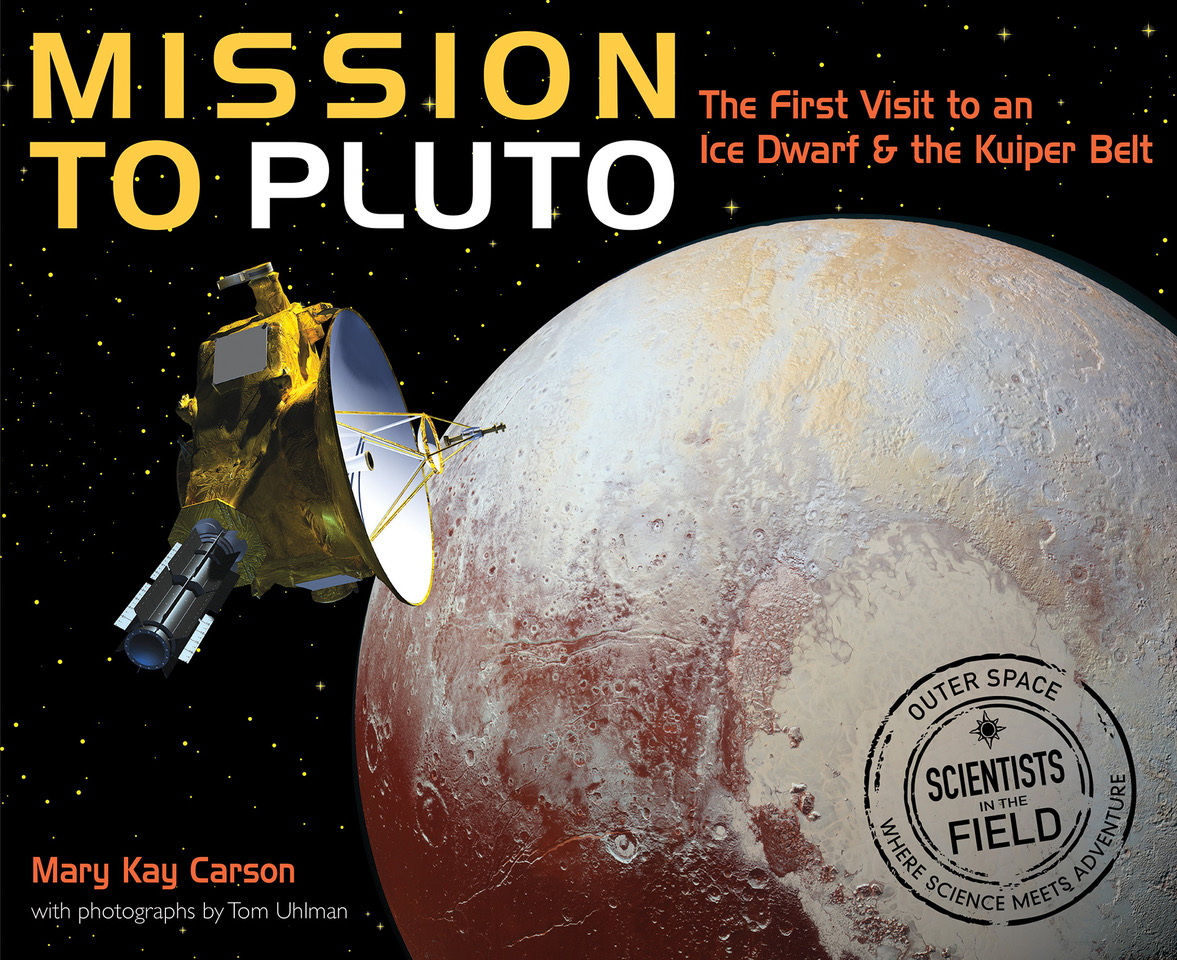
And the book got written, too. (Check!!) It’s called MISSION to PLUTO: The First Visit to an Ice Dwarf and the Kuiper Belt.


Mary Kay Carson is an author of nonfiction books for young people and a STEM Tuesday blogger. Her book Alexander Graham Bell for Kids received a 2019 AAAS/Subaru SB&F Prize. 
     She’s written six titles in HMH’s acclaimed Scientists in the Field series,including The Tornado Scientist(2019). www.marykaycarson.com


-----------------------------------------------------------------------------------------------

Nancy Castaldo has been writing about the planet for over 20 years. Learn more about her award-winning books at http://www.nancycastaldo.com

Coming this spring! Pre-order now! 

Wednesday, October 23, 2019

Researching STEM Kidlit - Welcome Guest Blogger Anita Silvey

The problem of the unreliable narrator – in primary sources ~~~
For the past six years, I have been working on a nonfiction trilogy for National Geographic about the “ape ladies” or trimates. With breakthrough field research, Jane Goodall (Untamed), Birute Galdikas (Undaunted) and Dian Fossey (Unforgotten) radically altered our understanding of our closest biological cousins -- the chimpanzees, orangutans, and mountain gorillas who share 97%+ of our DNA.


From the beginning, when I was asked by editor Kate Hale if I would be interested in a book on Jane Goodall, the project had everything I could desire – lots of primary sources, their own first-hand accounts, videos of them working in the field, people to interview who knew them, and foundations or the subjects themselves who could review the manuscript for any inaccuracies and misrepresentations. I should one day adorn my car with a bumper sticker “I brake for Primary Sources!” 
Then a year ago, I began researching the last of the three women for a biography of Dian Fossey, to be published in 2020. Within a couple of months, I realized I had a massive problem on my hands. After Dian Fossey was tragically murdered in her research camp, many who knew her provided interviews or wrote their own accounts of the incidents. I first picked up John Fowler’s A Forest in the Clouds, a fascinating adult biography. Then I read and reread Gorillas in the Mist, Dian’s account of her own journey. At that point, I realized I had a terrible problem in terms of telling the truth about Dian’s life. Like many creative people, Dian loved to tell a good story. But in her case, much of what she conveyed probably did not happen as she wrote or told it. We love to talk about the unreliable narrators in fiction, like Holden Caufield in The Catcher in the Rye or Nick and Amy in Gone Girl. For fiction, such an untruth teller can provide narrative tension, because the reader slowly begins to realize they cannot trust the point of view of the protagonist. But I am creating nonfiction; Dian’s willingness to bend the truth both in her book and in her letters led me into a research swamp, trying to check facts again and again.
Some of the final decisions were easier than others. For instance, when Dian was forced to flee her first research station in DRC, she told so many versions of the story and changed the details so many times, that I realized I could only convey the basics, leaving out some of her more dramatic, and less verifiable, claims. But what about the morning when she met with Louis Leakey after his lecture in Louisville, Kentucky? He told her he would find money to finance her study of mountain gorillas. In this case, I had only her account of events. Fortunately, I had already written about the pivotal meetings of Jane Goodall and Birute Galdikas with Leakey. Dian’s version of what happened that day matched their recollections down to small details. So I felt confident that I could rely on what she had said. Basically, I had to weigh everything she had said or written, understanding that I could not trust her own words.
Every book presents its own challenges; I can only hope that I have done Dian justice while attempting to tell the truth and nothing but the truth. But the whole experience makes me think I should redo that bumper sticker: “I brake for Primary Sources! Please tell the truth.”


Former Editor of Horn Book Magazine and Publisher of Children’s Books at Houghton Mifflin, Anita Silvey launched the Scientists in the Field series for young readers. Currently teaching at Simmons University, she has been writing a trilogy about the Trimates --  Jane Goodall (Untamed), Birute Galdikas (Undaunted), and Dian Fossey (Unforgotten). 

Watch for Anita's upcoming biography of Dian Fossey, UNFORGOTTEN!  

--------------------------------------------------------------------------------------------
-------------------------------------------------------------------------------------------------------------------------

Nancy Castaldo has been writing about the planet for over 20 years. Learn more about her award-winning books at http://www.nancycastaldo.com

DK LifeStories ADA LOVELACE is now available at your local bookstore!


Friday, May 4, 2018

Happy Birthday, Eugenie Clark!


It's the birthday of shark scientist Eugenie Clark.  She would have turned 96 today and according to biographer, Heather Lang, she probably would have still been scuba diving.


Eugenie was a force of nature and Lang spent time with her when writing her picture book biography, SWIMMING WITH SHARKS.  Lang even tried scuba diving during her research.

Read about this groundbreaking scientist in Lang's biography and in Jess Keating's, SHARK LADY.  Compare and contrast these terrific biographies.


Here are two more books for budding oceanographers! 


SaveSaveSaveSave

Wednesday, February 14, 2018

Award-Winning STEAM Kidlit


Congratulations to all the winners and honorees of the American Library Association book awards. It's always an exciting day when we can celebrate children's literature. 

Here are the award-winning titles that you should add to your STEAM bookshelf: 


*Vincent and Theo: The Van Gogh Brothers written by Deborah Heiligman and published by Godwin Books/Henry Holt, an imprint of Macmillan Children’s Publishing Group (art, biography) YALSA


The Whydah: A Pirate Ship Feared, Wrecked, and Found written by Martin W. Sandler, and published by Candlewick Press  (marine archeology)   YALSA honor


“Sea Otter Heroes: The Predators That Saved an Ecosystem,” written by Patricia Newman and published by Millbrook Press, a division of Lerner Publishing Group, Inc. (conservation, ecology) Sibert Honor


Wolf in the Snow,” illustrated and written by Matthew Cordell, and published by Feiwel and Friends, an imprint of Macmillan. (wildlife, wolves)


“Grand Canyon,” written and illustrated by Jason Chin and published by Roaring Brook Press, a Neal Porter Book. (environment) Sibert Honor, Caldecott Honor


Happy SEED SWAP DAY!

In light of the celebration of SEED SWAPPING DAY on January 31st, I'm posting this blog post again with a few updates -- so SEED ON!  ...